
www.electronics-usa.com
28
'26
Written on Modified on
Parker Chomerics launches reusable thermal gap filler pad
The THERM-A-GAP PAD 30RB delivers 3.0 W/m-K conductivity with excellent rebound for multiple assembly cycles.
www.parker.com
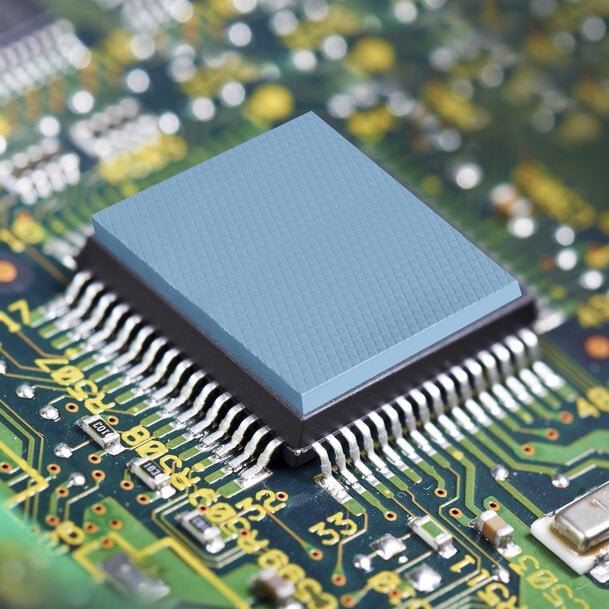
The Chomerics Division of Parker Hannifin has introduced the THERM-A-GAP PAD 30RB, a thermally conductive gap filler pad designed to maintain its physical and thermal performance across repeated compression cycles. Delivering a thermal conductivity of 3.0 W/m-K, the material allows users to compress and reapply the pad multiple times with minimal thickness loss, making it ideal for applications requiring reliable thermal management and iterative assembly or testing.
Conformability and low compressive load
Engineered to accommodate high stack-up tolerances, the gap filler minimizes compressive loads placed on fragile electronic components. The pad requires very low compression force to achieve optimal surface contact while simultaneously absorbing mechanical shock and dampening vibration within the assembly. This combination of flexibility and structural resilience makes it well-suited for demanding use cases, including automotive electronic control units (ECUs), telecommunications infrastructure, enterprise servers, and chipset testing environments where temporary but reliable thermal interfaces are necessary.
Electrical isolation and versatile integration
The RoHS-compliant material operates reliably in extreme temperatures ranging from -55°C to +200°C and carries a UL 94 flammability rating. Beyond its thermal impedance of 2.9 °C-cm²/W, the pad provides excellent electrical isolation with a volume resistivity of 10¹³ Ω-cm. To streamline manufacturing processes, the material is naturally tacky on both sides for secure positioning during assembly, with a single-sided tack option also available. It can be integrated with aluminum foil or Kapton polyimide film carriers, and is supplied in customizable die-cut parts or standard sheets ranging in thickness from 0.51 mm to 5.08 mm.
Additional Context: Compression set and mechanical stress in thermal interfaces
This section details material science dynamics and thermal management concepts not included in the original press release.
In electronics cooling, a thermal pad's "compression set"—its permanent plastic deformation after being subjected to compressive forces—is a critical failure mode in multi-cycle assemblies like chipset testing or device rework. Traditional silicone-based thermal pads often suffer from a high compression set; once compressed between a heatsink and a heat-generating component (such as an ASIC or CPU), they permanently thin out. If the heatsink is removed and reseated, microscopic air gaps form between the mating surfaces. Because air is an exceptional thermal insulator, these gaps drastically increase the thermal resistance of the interface, leading to component overheating. A pad engineered with high "rebound" utilizes a specialized elastomeric polymer matrix that recovers its original thickness upon decompression. Furthermore, minimizing the required compressive load (deflection force) is crucial for modern Printed Circuit Boards (PCBs) and Ball Grid Arrays (BGAs). Excessive mounting pressure required to compress a stiff thermal pad can induce severe mechanical stress, potentially leading to micro-fractured solder joints or a warped substrate.
Edited by an industrial journalist, Lekshman Ramdas, with AI assistance.
www.parker.com
