
www.electronics-usa.com
28
'26
Written on Modified on
Radiation-Hardened Multicore RISC-V Processors for Spaceflight Computing
Microchip validated radiation tolerance and initial silicon benchmarks for the PIC64-HPSC architecture to expand onboard autonomous spacecraft processing.
www.microchip.com
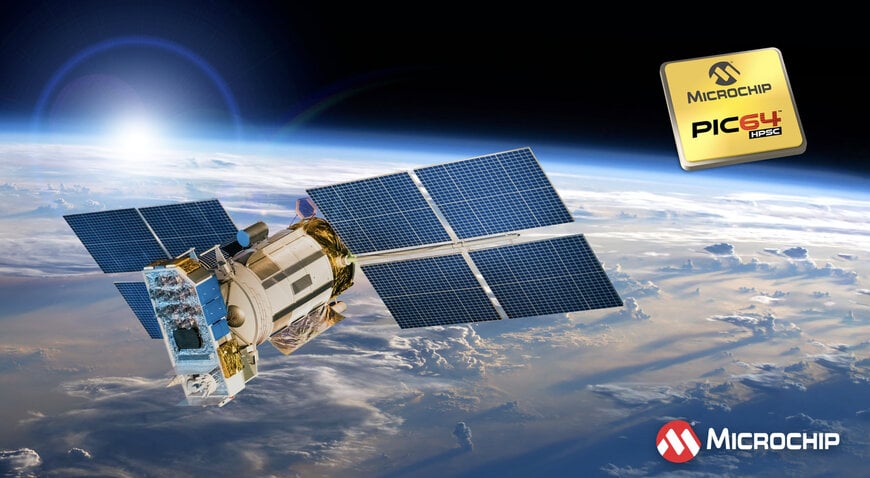
Spacecraft systems engineering faces severe computational bottlenecks as space exploration, Earth observation, and defense satellites transition from passive data relays into autonomous, software-defined platforms. Microchip Technology documented development milestones for the PIC64-HPSC (High-Performance Spaceflight Computing) Series, verifying that early radiation-hardened silicon met essential Total Ionizing Dose and latch-up immunity thresholds for deep-space and orbital instrumentation.
The Engineering Challenge of Onboard Aerospace Processing
Modern orbital payloads generate raw telemetry, multispectral imagery, and radar datasets that routinely saturate downlink bandwidth allocations. Downlinking raw data to terrestrial stations introduces transmission latency, demands high power output from radiofrequency transceivers, and restricts operational autonomy. Addressing this constraint requires high-throughput edge processing within the flight computer itself.
However, high-performance commercial processor architectures generally exhibit extreme vulnerability to space radiation environments. Cosmic rays and solar energetic particles induce destructive single-event latch-ups (SEL), functional interrupts, and cumulative degradation through total ionizing dose (TID) effects. Consequently, space missions have historically relied on flight computers with compute capacities decades behind terrestrial commercial standards. The development of the PIC64-HPSC platform originates from evaluations conducted by NASA and the Jet Propulsion Laboratory (JPL) to develop next-generation spaceflight computing systems capable of executing edge AI, complex sensor fusion, and real-time navigation without ground intervention.
Radiation-Hardened Architecture and Empirical Characterization
The PIC64-HPSC platform utilizes a 64-bit multicore RISC-V open standard instruction set architecture. Built on an open architecture, the processor provides deterministic computing paths and supports heterogeneous workloads across civil, scientific, commercial, and defense flight systems.
Microchip characterized early silicon using the PIC64-HPSC1000-RH radiation-hardened variant under controlled test procedures:
- Total Ionizing Dose (TID): Demonstrated endurance up to 200 krad(Si), ensuring silicon survival in extended medium-Earth orbit (MEO), geostationary transfer orbit (GTO), and interplanetary deep-space radiation environments.
- Single Event Latch-up (SEL): Achieved verified immunity to 78.2 MeV·cm²/mg, preventing destructive, heavy-ion-induced high-current short circuits.
- Single Event Effects (SEE): Evaluated system-controller operations under beam conditions, reporting no uncorrected data errors or requirement for external watchdog resets.
Form Factor Integration and Flight System Workflows
System integration for the PIC64-HPSC series proceeds through an Early Access Program that pairs developers with functional silicon, board support packages, and hardware development kits. To facilitate integration into standard spaceflight avionics racks, hardware partners are developing module designs around open industrial backplane standards, specifically VPX and VNX+ form factors.
By executing computational tasks onboard, platforms deployed from Low Earth Orbit to Mars missions can reduce telemetry loads and shorten sensor-to-decision timelines. These processing capabilities address key operational areas prioritized in civil aerospace technical roadmaps, enabling real-time planetary landing hazard avoidance, onboard hyperspectral image classification, secure cryptographic routing, and autonomous constellation station-keeping.
Additional Context:
This section details technical specifications and competitive benchmarking not included in the original product announcement.
The space avionics sector has historically relied on single-core or quad-core flight processors based on legacy architectures, most notably the BAE Systems RAD750 (PowerPC architecture fabricated on radiation-hardened silicon) and the Cobham Gaisler LEON4 (SPARC V8 architecture). The RAD750 operates at clock speeds up to 200 MHz, delivering approximately 266 DMIPS (Dhrystone Million Instructions Per Second) with typical TID tolerances of 100 to 200 krad(Si). By comparison, the HPSC project specification targets an order of magnitude improvement in compute performance—exceeding 100 times the computational throughput of heritage flight computers—by implementing an eight-core SiFive RISC-V CPU cluster alongside vector processing accelerators.
The transition to RISC-V in space avionics also mirrors broader industrial efforts to decouple aerospace embedded software from proprietary commercial instruction sets. In parallel with standard space-qualified 3U and 6U SpaceVPX (ANSI/VITA 78) architectures, the inclusion of the compact VNX+ standard addresses the strict size, weight, and power (SWaP) constraints of 12U to 27U CubeSats and SmallSats. The 78.2 MeV·cm²/mg SEL threshold directly complies with standard NASA and European Space Agency (ESA) component testing criteria (such as ESCC Basic Specification 25100 and ASTM F1192), ensuring that the physical silicon remains operational during peak solar particle events across unshielded interplanetary trajectories.
Edited by Natania Lyngdoh, Induportals editor, with AI assistance.
www.microchip.com
