
www.electronics-usa.com
05
'26
Written on Modified on
Same Sky introduces compact piano DIP switches for IoT applications
The new SMT and through-hole series offer low profiles and fine pitches for space-constrained designs.
www.sameskydevices.com
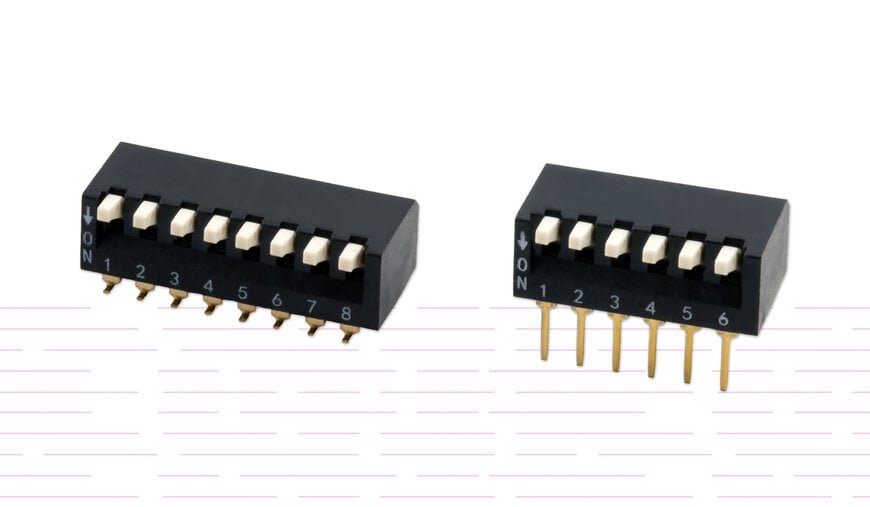
Same Sky’s Switches Group has expanded its component portfolio with the introduction of new ultra-compact piano DIP switches, encompassing the DS06-127-SMT, DS07-254, and DS08-254-SMT series. Engineered specifically for densely populated printed circuit boards (PCBs) in industrial, commercial, telecommunication, and IoT applications, the components feature highly miniaturized packages with widths down to 6 mm and profile heights as low as 4.2 mm.
Versatile configurations and electrical reliability
To accommodate diverse board layouts and manufacturing requirements, the new piano DIP switches are available in both surface mount (SMT) and through-hole mounting styles, featuring either gull-wing or standard PC pin terminations. Engineers can specify the switches with 2 to 10 positions, utilizing either standard 2.54 mm or fine 1.27 mm pitches. The series also offers options for flush or raised actuators to suit different manual configuration needs. Electrically, the switches are rated for 25 mA switching currents (at 24 Vdc) and 100 mA non-switching currents (at 50 Vdc). Built to withstand demanding operating environments, the components feature a broad thermal operating range of -40°C up to 85°C.
Additional Context: Switching vs. non-switching current ratings in electromechanical contacts
This section details the contact physics and electrical limits of physical switches not included in the original press release.
In electromechanical switches like DIP (Dual In-line Package) components, manufacturers specify two distinct electrical ratings: switching (or "make/break") current and non-switching (or "continuous") current. The switching current rating (in this case, 25 mA) is always significantly lower due to the transient physical phenomena that occur precisely when the metallic contacts meet or separate. During this microsecond transition, the actual contact area is microscopic, causing localized high electrical resistance and heat. Furthermore, separating live, energized contacts can draw microscopic electrical arcs that vaporize plating materials (such as gold or silver alloys), leading to pitting, oxidation, and eventual contact failure or micro-welding. Conversely, the non-switching rating (100 mA) applies only when the contacts are already firmly closed and fully mated. In this static state, the maximum surface area is engaged, allowing the metal to safely conduct a much higher current based solely on the component's thermal dissipation limits, entirely avoiding the destructive risks of electrical arcing.
Edited by an industrial journalist, Lekshman Ramdas, with AI assistance.
www.sameskydevices.com
