
www.electronics-usa.com
08
'26
Written on Modified on
TDK AIsight DSP Platform for AI Glasses
New ultralow-power vision DSP from TDK AIsight positions the company in the AI glasses and wearable computing space for context-aware sensing and eye-intent tracking.
www.tdk.com
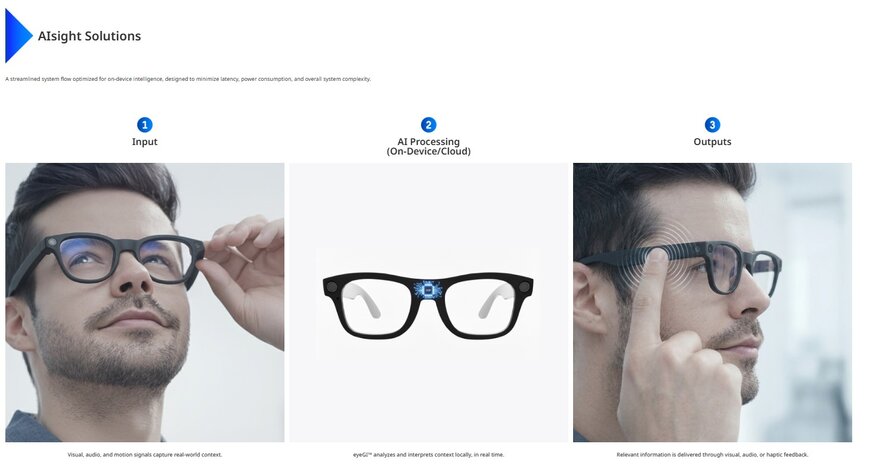
TDK Corporation has created a dedicated business unit, TDK AIsight, and introduced an ultralow-power digital signal processing (DSP) platform targeting AI glasses and related wearables. The initiative aims to enhance the digital supply chain for next-generation human-machine interaction by combining hardware and software optimized for physical and generative AI workloads.
Emergence of TDK AIsight and Strategic Focus
TDK AIsight is structured to integrate semiconductor, sensor, and algorithmic competencies into end-to-end systems that interpret user intent and environment through vision and eye tracking. The new entity was announced in conjunction with demonstrations at the Consumer Electronics Show (CES) 2026 in Las Vegas, Nevada (January 6–9, 2026).
The company combines microelectronics, sensors, and AI software to support “physical AI” — defined as systems that perceive and interact with the physical world via sensor data — alongside generative AI capabilities. Physical AI in this context refers to localized interpretation of visual cues and user gaze to drive context-aware functions in wearable devices.
Technical Characteristics of the SED0112 DSP
The first product from TDK AIsight is the SED0112, a DSP platform integrating a microcontroller, a state machine, and a hardware convolutional neural network (CNN) engine on a single chip. Key technical attributes include:
- Hardware CNN for Vision Workloads: The integrated CNN accelerator is optimized specifically for eye-intent processing, enabling direct inference on visual inputs without continual dependence on an external host processor.
- Ultralow Power Consumption: Designed for wearables, the microcontroller DSP supports programmed workflows that allow the host processor to remain in low-power or off states until visual events of interest are detected.
- Multi-Sensor Support: The architecture accommodates multiple vision sensors with variable resolutions, supporting both eye tracking and contextual scene analysis.
- Compact Package: The device is offered in a 4.6 mm × 4.6 mm package with interfaces for up to four dedicated eye sensors (SES0111) and a context sensor (SES0113).
The platform is positioned for AI glasses, augmented reality (AR) devices, and industrial smart eyewear. Use cases center on:
- Eye-Intent Detection: Low-latency, localized detection of gaze direction or eye gestures to trigger UI changes or context-specific functions.
- Context Awareness: Processing of scene imagery to infer user intent or environmental cues before engaging higher-level compute resources.
- Energy-Constrained Wearables: DSP power management enables sustained operation in battery-limited form factors typical of consumer and enterprise glasses.
Such functionality supports interactions where conventional interfaces (touch or voice) are impractical, such as hands-free environments or industrial settings requiring continuous situational awareness.
Relevance in the Broader Wearable and AI Ecosystem
TDK’s move reflects a broader industry trend toward embedding more advanced sensing and localized AI inference directly within wearable devices. Analysts project significant growth in smart glasses shipments in the coming years as the digital supply chain diversifies and integrates more efficient power and sensing technologies. Building foundational components like ultralow-power DSPs that handle vision and eye-tracking workloads locally can reduce dependence on cloud connectivity while lowering energy use.
By leveraging its existing portfolio — notably sensors, batteries, and passive components — TDK AIsight aims to differentiate offerings along metrics such as power efficiency and integration density, which are key constraints in wearable design.
Industry Positioning and Competitive Landscape
Comparable vision DSPs exist from established semiconductor vendors, often focused on mobile and automotive markets. TDK’s emphasis on combining hardware with proprietary eye-intent algorithms within a tightly integrated power envelope targets a specific subset of the wearable market where low energy consumption and fast contextual awareness are critical. Objective benchmarks include inference throughput (operations per second), power per inference, and sensor fusion latency, though specific published data on these metrics for the SED0112 remain limited at this stage.
Overall, the platform contributes to the foundational technology stack for wearable AI, addressing both hardware and algorithmic layers in the emerging automotive data ecosystem and consumer wearable segments.
www.tdk.com
Relevance in the Broader Wearable and AI Ecosystem
TDK’s move reflects a broader industry trend toward embedding more advanced sensing and localized AI inference directly within wearable devices. Analysts project significant growth in smart glasses shipments in the coming years as the digital supply chain diversifies and integrates more efficient power and sensing technologies. Building foundational components like ultralow-power DSPs that handle vision and eye-tracking workloads locally can reduce dependence on cloud connectivity while lowering energy use.
By leveraging its existing portfolio — notably sensors, batteries, and passive components — TDK AIsight aims to differentiate offerings along metrics such as power efficiency and integration density, which are key constraints in wearable design.
Industry Positioning and Competitive Landscape
Comparable vision DSPs exist from established semiconductor vendors, often focused on mobile and automotive markets. TDK’s emphasis on combining hardware with proprietary eye-intent algorithms within a tightly integrated power envelope targets a specific subset of the wearable market where low energy consumption and fast contextual awareness are critical. Objective benchmarks include inference throughput (operations per second), power per inference, and sensor fusion latency, though specific published data on these metrics for the SED0112 remain limited at this stage.
Overall, the platform contributes to the foundational technology stack for wearable AI, addressing both hardware and algorithmic layers in the emerging automotive data ecosystem and consumer wearable segments.
www.tdk.com
