
www.electronics-usa.com
06
'26
Written on Modified on
Advanced microcontrollers power the physical AI revolution
STMicroelectronics reveals advanced microcontrollers for real-time power control in AI data centres and robotics.
www.st.com
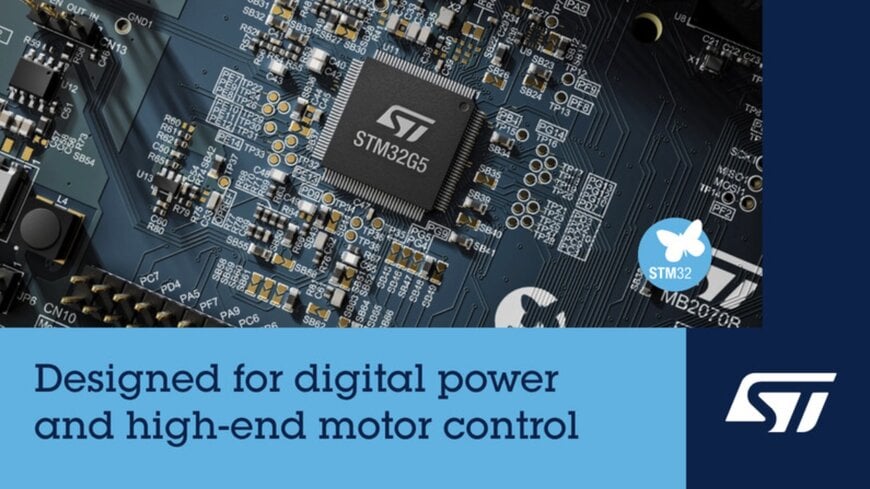
Power architectures in hyperscale artificial intelligence data centers and advanced robotic systems face critical efficiency and density challenges. As accelerated computing clusters elevate server rack power requirements toward one megawatt and project multi-gigawatt facility draws, power distribution units and server power supply units must operate at elevated switching frequencies to maximize conversion efficiency and reduce cooling loads. Historically, digital power designers and robotics engineers faced difficult trade-offs between dedicated digital signal processors and general-purpose microcontrollers. General-purpose processing cores often lacked the ultra-fine pulse-width modulation resolution required to govern wide-bandgap silicon carbide and gallium nitride switching stages, while traditional microcontrollers required external discrete logic and dedicated secure elements to handle fault states and cloud authentication. Simultaneously, dexterous robotic manipulation in humanoid platforms demands high-density, multi-axis motor driving across constrained physical footprints, such as robotic hands integrating up to twenty individual actuators. Addressing these operational demands requires mixed-signal microcontroller architectures that combine high-frequency real-time execution with specialized hardware timers, configurable logic, and embedded root-of-trust security.
Mixed-Signal Processing Architecture and Dynamic Power Conversion
To resolve power density and physical robotics control bottlenecks, STMicroelectronics introduced the STM32G5 series of mixed-signal microcontrollers. Engineered around the Arm Cortex-M33 core clocked at 280 MHz with hardware floating-point acceleration, the architecture delivers double the compute performance of the preceding STM32G4 family, achieving 1,136 CoreMark and 420 DMIPS. ST plans to expand the portfolio in 2027 with dual-core configurations to provide additional processing headroom and peripheral distribution.
The platform introduces an upgraded twelve-channel high-resolution timer system engineered to govern complex power supply topologies. By delivering timing resolution down to 111 picoseconds, the timer enables equipment manufacturers to modulate duty cycles, phase shifts, and dead-times with sub-nanosecond accuracy. This granular timing permits direct drive of high-frequency wide-bandgap gallium nitride (GaN) and silicon carbide (SiC) semiconductors, enabling server power supplies to dynamically adjust operating stages in response to abrupt transient load spikes generated by parallel graphics processing units.
Precision Motion Control and On-Chip Hardware Logic
For physical robotics and industrial automation, the STM32G5 integrates dedicated motion peripherals alongside analog measurement blocks. An onboard position encoder interface decodes multi-turn absolute encoder protocols directly in hardware, offloading angular feedback decoding from the central processing core. This real-time loop execution supports simultaneous multi-axis motor control across high-torque robotic joints and compact end-effectors, facilitating coordinated motion in dexterous humanoid hands without external processing bridges.
To reduce system complexity and bill-of-materials costs, the microcontroller incorporates the new PLAy programmable logic array. The embedded programmable logic fabric contains sixteen configurable logic elements connected across internal crossbars and input-output lines, allowing hardware engineers to map custom interlocks, fault blanking, and glue-logic functions directly onto the silicon die without external discrete logic gates.
Silicon-Level Cryptography and Software Ecosystem
Addressing tightening data center security standards and firmware protection mandates, the STM32G5 implements an immutable Root of Trust (STiRoT) alongside support for an updatable Root of Trust, establishing verified hardware secure boot and authenticated remote firmware installation. The integrated cryptographic subsystem features dedicated acceleration engines supporting side-channel attack resistance, hardware tamper detection, and ST's post-quantum cryptography (PQC) libraries to protect infrastructure against emerging quantum-decryption vectors. Physical separation is enforced through Arm TrustZone security boundaries, isolating power-stage state machines and cryptographic keys from operational communications.
Development workflows are supported by the updated STM32CubeMX2 software configuration utility, which introduces real-time code previews, interactive clock tree configuration, and graphical pinout mapping. The series also incorporates the redesigned STM32Cube Hardware Abstraction Layer (HAL2), which optimizes flash and static RAM footprints while granting direct access to low-level peripheral registers.
Additional Context
This section details technical specifications and competitive benchmarking not included in the original product announcement.
In digital power conversion and motor drive design governed by standards such as IEC 60730 (safety requirements for electronic controls) and IEC 62443 for industrial cybersecurity, control-loop propagation delay directly determines transient performance. Modern multi-phase interleaved totem-pole power factor correction (PFC) circuits and resonant LLC converters operating in AI server power supplies often switch at frequencies ranging from 500 kHz to above 2 MHz. At these elevated frequencies, traditional pulse-width modulation timers with clock resolutions above one nanosecond introduce limit-cycle oscillations, degrading efficiency and increasing voltage ripple. The STM32G5’s 111-picosecond timer resolution enables continuous dead-time management, avoiding shoot-through currents in high-voltage GaN half-bridges. Furthermore, by pairing this timer with high-speed analog-to-digital converters sampling at 5 megasamples per second and ultra-fast sub-20-nanosecond analog comparators, the microcontroller can execute cycle-by-cycle overcurrent tripping autonomously in hardware before excessive fault currents reach power transistors.
Within the real-time mixed-signal microcontroller market, the STM32G5 competes directly against established digital power and industrial drive solutions, including Texas Instruments’ C2000 real-time MCU family (such as the TMS320F2800x and F2838x series), Microchip Technology’s dsPIC33C digital signal controllers, Renesas Electronics’ RA6T2 and RX72T families, and NXP Semiconductors’ MCX W and MCX N series. While the C2000 platform has historically dominated industrial server power through its proprietary C28x DSP core and trigonometric math units, it often requires proprietary compiler toolchains and external secure element silicon to meet modern cloud-infrastructure cryptographic mandates. In contrast, the STM32G5 leverages a standardized Arm Cortex-M33 architecture integrated with Arm TrustZone and native post-quantum cryptographic libraries, targeting PSA Certified Level 3 and SESIP Level 3 security ratings. This architectural convergence eliminates the need for separate cryptographic co-processors on server power shelves and motor drive enclosures, lowering overall board area and simplifying supply chain management for high-density power systems.
Edited by Romila DSilva, Induportals Editor, with AI assistance.
www.st.com
