
www.electronics-usa.com
21
'26
Written on Modified on
Solid-State Transformers and Sensors for AI Infrastructure
TDK Corporation presents power conversion, thermal management, and sensing components at electronica 2026 to solve energy efficiency bottlenecks in industrial automation.
www.tdk.com
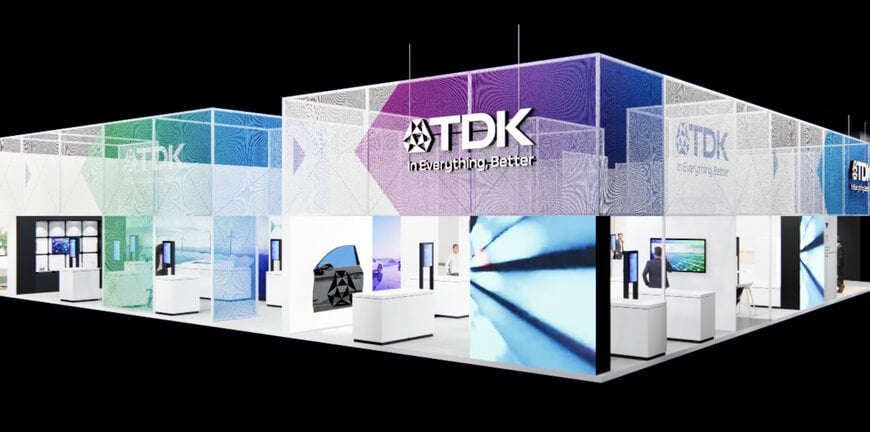
At electronica 2026 in Munich, Germany, from November 10 to 13, 2026, TDK Corporation will present power electronics, sensing subsystems, and passive components designed for high-density computing and physical artificial intelligence (AI) systems. These hardware architectures address thermal dissipation, voltage conversion, and signal integrity challenges across AI infrastructure, industrial automation, and automotive electronics.
Core Technology and System Architecture
As AI expands into physical infrastructure, system engineers face increasing power density and sensing requirements. TDK Corporation addresses medium-voltage grid integration for AI data centers through a modular solid-state transformer (SST) architecture. The SST converts medium-voltage alternating current (AC) between 10 kV and 35 kV directly to 800 V direct current (DC). By connecting multiple nodes in series at the input and in parallel at the output, and integrating silicon carbide (SiC) devices with high-frequency magnetic modules and passive components, the system enables bidirectional power flow and reduces conversion losses.
For optical data communication in server clusters, an optical transceiver architecture integrates aluminum nitride (AlN) substrates for thermal conductivity, thin-film capacitors, power inductors, negative temperature coefficient (NTC) thermistors, and DC-DC converters. In wearable and edge hardware, TDK combines micro-electro-mechanical systems (MEMS) and tunnel magnetoresistance (TMR) sensors with sensor fusion algorithms for motion tracking, alongside a 150 nm thick nanostructured meta-optic mirror embedded in eyeglass lenses to project retinal images without conventional curved optics.
Deployment and Implementation
At the Munich exhibition, systems are distributed by engineering domain. TDK Corporation occupies Hall B5, Stand 520, while subsidiary TDK-Lambda demonstrates power supply architectures in Hall A5, Stand 503, and ICsense presents mixed-signal integrated circuit designs in Hall C4, Stand 100. System-level integration is also demonstrated through third-party hardware implementations: the Nibotics Dexterous Hand integrates TDK pressure, force, slip, and temperature sensors for industrial manipulation, while WEART integrates multilayer piezoelectric PowerHap actuators into its TouchDIVER haptic glove to render physical surface textures in virtual environments. Additionally, TDK will establish an accredited electromagnetic compatibility (EMC) testing laboratory in Regensburg, Germany, in early 2027 to support compliance engineering alongside its existing facilities in Japan, China, and the United States.
Industry Applications
In AI data centers, liquid-cooling coolant distribution units (CDUs) require continuous monitoring to prevent thermal throttling. TDK integrates pressure and temperature sensors to monitor fluid loops, TMR sensors for rotor angle detection in valve-control motors, and EMC filters to suppress electromagnetic interference.
In industrial automation, the VIBO industrial Internet of Things (IoT) edge vibration sensor monitors rotating equipment such as motors, compressors, vacuum systems, and pumps. Utilizing a digital architecture with a 20 kHz bandwidth and a Modbus interface, the sensor detects early-stage mechanical anomalies, including bearing wear, gearbox defects, and cavitation.
In electric vehicles, a traction inverter demonstrator combines the CUR 3020 AC-phase current sensor, high-capacitance-density DC-link capacitors, EMC filters, and magnetic rotor position sensors to stabilize current flow and motor commutation. For software-defined vehicle zonal electronic control unit (ECU) architectures, common-mode chokes and power-over-coax inductors maintain signal integrity and power delivery across camera and sensor networks.
Operational Impact and Performance Metrics
The deployment of these components provides quantifiable operational control and testing capabilities. For laboratory validation and industrial testing, the 19-inch rack-mounted GENESYS AC programmable power sources deliver 2 kVA to 3 kVA in a 1U form factor and 6 kVA to 9 kVA in a 3U form factor. These units support parallel configuration and generate single-phase or three-phase outputs from 0 V to 350 V AC across frequencies from 16 Hz to 1.2 kHz (extending to 5 kHz in PRO configurations), alongside DC outputs up to plus or minus 500 V, incorporating standard IEC and avionics test libraries. In wearable audio interfaces, MEMS microphones utilize an Acoustic Activity Detect function to gate processing, allowing host AI processors to remain in ultra-low-power states until relevant acoustic signals occur.
“As AI becomes increasingly embedded across infrastructure, intelligent systems, and devices, the need for energy efficiency, sensing, computing, and connectivity continues to grow,” notes Noboru Saito, President and CEO of TDK Corporation.
Edited by Sucithra Mani, Induportals editor – adapted by AI
www.tdk.com
