
www.electronics-usa.com
11
'26
Written on Modified on
STMicroelectronics Expands NB-IoT Platform Across Americas Markets
New certifications enable scalable IoT deployments with NB-IoT connectivity, positioning capabilities and simplified integration across regions.
www.st.com
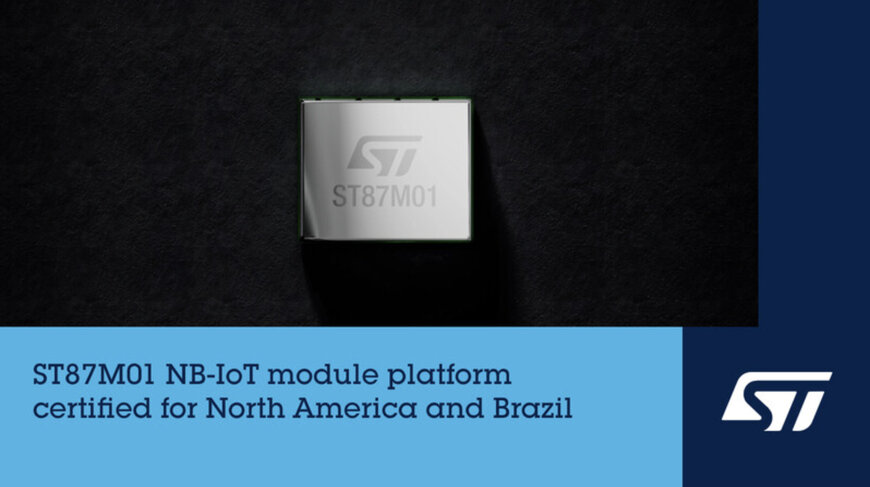
STMicroelectronics has obtained comprehensive telecommunications and interoperability certifications for its narrowband internet of things module series across North American and Brazilian jurisdictions. This technical achievement enables the immediate deployment of 5G-ready cellular hardware within specialized tracking networks and automated public utility sectors, streamlining international product commercialization.
Structural Architecture and Geolocation Integration Topologies
The industrial microchip platform incorporates 3GPP Release 15 cellular connectivity parameters directly into an ultra-compact land grid array package measuring 10.6 by 12.8 millimeters. The physical architecture functions by merging narrowband internet of things transceivers with optional concurrent global navigation satellite system receivers and localized Wi-Fi hotspot scanning sub-chips. By integrating these multiple radio-frequency stages onto a single silicon substrate, hardware developers bypass typical signal-coexistence engineering barriers and separate component overhead costs.
The hardware operates inside an industrial temperature range from -40 to +85 degrees Celsius, delivering a maximum radio frequency output power of +23 dBm. To manage peripheral sub-assemblies on the circuit board, the system exposes twenty-four general-purpose input-output lines alongside two individual internal analog-to-digital converters. This configuration permits external sensors to link directly to the communication module without requiring a dedicated host microcontroller, shrinking the total electronic footprint and curbing processing latency.
Network Interoperability and Regional Fleet Orchestration
To accelerate deployment times within the United States and Canadian commercial markets, the module family has secured compliance approvals under Federal Communications Commission, PCS Type Certification Review Board, and Innovation, Science and Economic Development frameworks. This radio-frequency clearance is paired with an operational partnership alongside network operator Onomondo to deliver a native, fully managed virtual cellular layer. This configuration allows field systems to automatically attach to roaming profiles across North American macro networks without requiring localized SIM changes or complex manual carrier onboarding protocols.
For the South American market, the system has achieved national Anatel certification in Brazil, granting authorized access to regional connected infrastructure projects. The primary application use cases across these dynamic utility markets focus on automated gas and electricity smart metering installations, urban street lighting control nodes, and agricultural remote livestock telemetry arrays. The integrated firmware architecture runs native embedded internet protocol stacks—including transport control protocol, message queuing telemetry transport, and lightweight machine-to-machine protocols—which route telemetry packets directly through cellular base stations to centralized fleet management engines.
Power Saving Mechanics and Lifecycles
The cellular modules enforce strict power management regimes to secure an operational field life reaching up to fifteen years from standard primary battery configurations. The energy-saving topology relies on native software implementations of Power Saving Mode and Extended Discontinuous Reception protocols defined by telecommunications authorities. When entering these deep sleep parameters, the transceiver cuts its idle power draw to a typical baseline consumption of 1.2 microamps.
The active connection management handles remote system maintenance via differential firmware-over-the-air updates managed through standard AT command structures. This orchestration method permits operators to push security patches and routing table revisions incrementally across thousands of active field nodes simultaneously. By restricting updates to compressed delta files, the system shortens radio transmission intervals, prevents network congestion, and preserves the structural capacity of localized battery packs.
Additional Context:
This section details technical specifications and competitive benchmarking not included in the original product announcement
The scaling of cellular narrowband internet of things technology represents a distinct performance alternative to low-power wide-area networks operating on unlicensed spectrum, such as LoRaWAN or Sigfox topologies. Unlicensed spectrum technologies benefit from low initial network infrastructure costs but suffer from unmanaged radio-frequency collisions, strict duty-cycle transmission caps, and low resistance to deliberate signal jamming in dense urban environments. The narrowband internet of things framework completely avoids these operational hazards by transmitting exclusively within licensed cellular spectrum allocations, guaranteeing a deterministic quality of service and superior signal penetration depths inside building basements or heavy industrial concrete facilities.
In comparison to alternative standard cellular modems based on legacy LTE Cat-M1 architectures, the narrowband internet of things land grid array module balances reduced data transmission bandwidth against a significantly lower power footprint and miniature physical dimensions. While Cat-M1 modems handle higher peak data rates and support voice features, they exhibit typical sleep currents that exceed the 1.2 microamp baseline of the solid-state architecture by multiple orders of magnitude. Furthermore, the combination of cellular tracking, multi-constellation satellite navigation, and internal Wi-Fi hotspot fingerprint scanning within a single 10.6 by 12.8 millimeter perimeter prevents the implementation complexities of multi-chip layouts, where separate component clocks and traces frequently induce thermal throttling and localized electromagnetic interference.
Edited by Natania Lyngdoh, Induportals editor, assisted by AI.
www.st.com
